Posts mit dem Label Systeme werden angezeigt. Alle Posts anzeigen

Sonntag, 24. Mai 2026

Selbstverstärkende Inkompetenz

Die Gesellschaft versteinert in Prozessen, die alles immer kleinteiliger regeln und dann an jeder Stelle im Prozess maximale Inkompetenz und Handlungsunfähigkeit etabliert. 

Beispiel aus dem Alltag. 

Eine Filiale einer Bäckerei bietet Rührei mit Schinken und Spiegelei (ohne) an. Frage, ob man Spiegeleier mit Schinken machen könnte, führt zu Konferenz überforderter Mitarbeiter bei gleichzeitiger Unterbrechung aller laufenden Prozesse. 

Der Urteilsspruch fällt, nein, das wäre nicht möglich, ist in der digitalen Kasse nicht vorgesehen. 

(1) Prozesse sind bis auf die Form des verarbeiteten Eis spezifiziert, damit diese Rolle auch von dem am wenigsten geschulten Mitarbeiter umgesetzt werden kann

(2) Die Erwartungshaltung der Unternehmensführung (ebenso Prozess-kleinteilig gestaltet, mit maximaler Diffusion jeder Verantwortung und Bürokratie), dass die Mitarbeiter nicht in der Lage sind einen klaren oder praktischen Gedanken zu fällen, selbstbestätig sich dann in der Praxis. Denn niemand kommt auf die Idee, die Rühreier in der Kasse zu verrechnen die Eier bei der Zubereitung aber nicht zu verrühren.

Die Erwartung der totalen Inkompetenz der Mitarbeiter führt zu einem strukturellen Korsett, dass die strukturelle und totale Inkompetenz der Mitarbeiter erst hervorruft.

Wer Erwachsene wie Kinder behandelt, darf sich nicht wundern, wenn sie sich irgendwann wir Kinder benehmen.

Donnerstag, 24. August 2023

Understanding or Solving?

“In the academic world of the social sciences, research designed to understand a problem is often held in higher regard than research to solve the problem. […] it is based on the false assumption that understanding a problem is the key to solving it. This is not true for the toughest problems, the “wicked” ones,”, Daniel Yankelovich, Wicked Problems, Workable Solutions

“The Fallacy of Exquisite Measurement, which states that the ability to measure things down to very fine detail does not automatically confer a power to control things.”, James Howard Kunstler, Living in the long emergency


Donnerstag, 13. Juli 2023

Eiszeit oder Klimakrise? Wissenschaft, komplexe Systeme und Prognosen.

In den 1970er Jahren wurde zur gleichen Zeit vor einer neuen Eiszeit und vor dem Klimawandel gewarnt, das sollten wir nicht aus den Augen verlieren:

»What scientists are telling us now is that the treat of an ice age is not as remote as it was once thought. [...] If we are unprepared, the result could be hunger and death on a scale unprecedented.«

Besonders die 1970er Jahre waren eine Zeit steter apokalyptischer Prognosen, von denen keine eingetroffen ist. In den meisten Fällen ist sogar das Gegenteil eingetreten.


Wissenschafter prognostizieren eine Menge über die Zeit. Vor allem wenn es sich um komplexe Systeme dreht, sind die Prognosen häufiger falsch als richtig. Leider mangelt es vielen an der Bescheidenheit, das einzugestehen. Apokalyptik verkauft sich besser, so wie es aussieht wohl auch in der Wissenschaftsfinanzierung.

Bedeutet das, dass der Klimawandel kein Problem ist? Natürlich nicht. Es bedeutet aber, dass wir uns viel breiter als Gesellschaft auf alle möglichen Probleme vorbereiten sollten und keinesfalls wie das Kaninchen auf die Schlange Klimawandel blicken sollten. Das geht in die Hose. Vor allem auch dann, wenn die Maßnahmen so ungeschickt sind — wie wir sie heute etwa in der Energiepolitik erleben — und damit die Medizin mehr Schaden als die Krankheit anrichtet.

»We are always well prepared for the wrong disaster. […] But history warns us that you don’t get the disaster you prepare for.« , Niall Ferguson


Freitag, 23. Juni 2023

Existential Threats

What is an existential risk? The Cambridge Existential Risks Initiative (CERI) uses the following definition:

“An 'existential risk' (x-risk) is an event that could permanently and drastically reduce humanity’s potential, for example by causing human extinction.”, CamXRisk

A problem with discussing existential risks is that the definitions or understandings of it are quite ambiguous. Also, the Cambridge definition has a weakness. What does drastically mean specifically? 

I would try my own definition:

An existential risk to humanity is a threat that could damage large parts of the planet or human structures or kill  large parts of humanity to an extent or in a way, that a recovery to modern levels of society is not likely within a timeframe of a centuries.  

Every definition has its weaknesses, but I think we have a working understanding of what we are talking about. Of course, even if an existential threat does not go the full way, say we would face a nuclear exchange that is limited to Europe, the effects on the global society might not be existential in the narrow sense of the meaning but still very dramatic. Lastly, we have to keep further parameters in view, such as timeframe (how fast does the risk play out once it happens) and range of effects (how far-reaching is the effect, e.g. does it hit “only” humanity, or the whole global ecosystem).


Now having the definition game out of the way, what existential risks are out there, can we list and maybe even rank them? Or does a ranking of existential threats make no sense at all?  Existential means, (1) huge consequences when the worst case happens and evidently also (2) it did not happen yet, at least not to our modern society. That means, we have no proper statistical basis to draw reliable conclusions from. A ranking could be based on probabilities of entry and severity of effect. But as we do not have sufficient data from prior cases for that reason, probability of entry are very vague and usually just guesses. The same is true for the severity of the effect. As Niall Ferguson writes:

“A pandemic is made up of a new pathogen and the social networks that it attacks. We cannot understand the scale of the contagion by studying only the virus itself, because the virus will infect only as many people as social networks allow it to. At the same time, a catastrophe lays bare the societies and states that it strikes”

This is not only true for pandemics, but for other societal and potential existential risks as well. To estimate the effect of an existential risk thus means (1) we have to understand the mechanic of the risk very well and (2) how societies react to it. For that reason, the situation can be counterintuitive in numerous instances. For instance, climate changes and yet predicted (and reported) effects do not actually happen:

“annual US deaths from tornadoes have fallen by more than a factor of ten since 1875” 

or extreme weather events might increase in some places and still:

“weather-related death rates fell dramatically during the past one hundred years even as the globe warmed 1.2°C (2.2°F); they’re about 80 times less frequent today than they were a century ago. That’s largely due to better tracking of storms, better flood control, better medical care, and improved resilience as countries have developed. A recent UN report confirms the trend over the past two decades.”, Steven Koonin, Unsettled

Of course, this could change significantly should we come into a runaway situation, which some climate scientists are afraid of but others dispute. The bottom line is: we usually know much less about the mid or long-term outcomes of complex systems than we think we do.

So, any ranking of existential risks tends to be a fools' errand. Thus, in my list the ranking is not to be taken too seriously, but it is not entirely negligible. For instance,  nuclear weapons are number one for a good reason: There is a reasonable chance for a full nuclear exchange, and the consequences are absolutely catastrophic, mitigation and adaptation are minimal, and all that happens in a very short timeframe. Whereas population collapse is a significant threat for our society and there is little room for mitigation, but plays out over decades or centuries, and we can hope for adaptation measures. Climate change is in between, and actually very similar in its mechanic: there is not a lot we can actually do to mitigate, especially in a short time frame, and the effects will most likely play out over long periods of time, which again, opens room for adaptation. But the effects are wider ranging than population collapse, in that the whole biosphere is effected.

These are the reasons why climate change is not in the top five in my list. It is not one event, it is gradual and adaptation much more likely than a nuclear war. Other large humanitarian problems like hunger, poverty or malaria are not on that list either. These, and many others, are terrible threats to human flourishing in parts of the world but are not threatening humanity in a larger or long-term sense. They are rather effects of other problems. Again, this does not mean, we should not do anything against those, but it is simply not the focus of this discussion.

Systemic aspects of most existential threats forbid a naive reading, in the sense, that we should work the list from top to bottom and only continue to “the next action item” once we have completed the previous. In fact, the most fundamental insight is, that there is not one “biggest problem”, not even three or five. Living in a modern, complex society — in the Anthropocene — has positive effects:  we are farther away from nature, safer and with much higher living standards than ever before. We do not die any longer in harmony with nature, as Hans Rosling put it. But it also has negative effects which can be, unfortunately, existential. Many, if not most, of the threats on this list are connected in complex ways. This means, we most likely cannot solve any of those, especially not in isolation. But it also means that we got our priorities wrong in the last decades. 

»We are always well prepared for the wrong disaster. […] But history warns us that you don’t get the disaster you prepare for.« , Niall Ferguson

and

“For every potential calamity, there is at least one plausible Cassandra. Not all prophecies can be heeded. In recent years we may have allowed one risk — namely climate change — to draw our attention away from the others.”

Also, as mentioned above, some threats are on the list are not isolated but can be seen as a potent trigger for other threats, e.g. political extremism or collapse of infrastructure.

Thus, focusing on the mitigation of one risk alone (e.g. climate change), can dramatically increase other risks, as each medication has side effects. Would we, for instance, Just stop oil, this would be a guarantee of an existential disaster for humanity. Often, we did not only get the priorities wrong, but our activities were so inept that they, in fact, increased the risk they were supposed to mitigate and also negatively affected many other risks, especially the ones higher on the list. 

Not focusing our attention on one risk alone is clearly not easy considering the dominating mode of (legacy) media and politics. But it is like not smoking to stay healthy, while at the same time driving a motorcycle and doing wingsuit jumps from mountains. Whatever we do should be a wide-ranging approach, trying to make our society more resilient against various risks, for instance: 

  • Increasing diversity (in supply chains, food production, energy systems, ...).
  • Providing redundancy for important services (grid replacement part agains Carrington events, emergency hospital beds, etc).
  • Preparing for catastrophes with emergency management, properly funded military, etc.
  • Decoupling (for instance financial services), so that a catastrophe in one country does not immediately spill over to others.
  • Creating smaller decoupled, redundant structures that organise bottom up, not heavyweight top down ones.
  • Making societies more wealthy and educated in general helps the society to be better adapted to critical events. This clearly stands in opposition to the ideas of many “progressives”.
  • Try to estimate the positive effects of an intended measure per Euro spent instead of following ideology-driven activities.

One example, where we failed in an embarrassing way and saw our near total lack of preparation is the Covid crisis, to just mention a few aspects:

  • Even though pandemics of this type happened in the past and were predicted by experts, we had no proper studies, which emergency measures would be actually helpful (and even three years later the knowledge is scarce). 
  • We had no PPE stocked in reasonable quantities, not even for medical personel.
  • We had not even crisis processes defined. In the middle of the first lock down, I followed a discussion in German media, where experts were contemplating, where infected people should do. Should they go to the general practitioner or not, to the hospital, etc? 
  • We had no clear and unifying reporting framework established, and even years into the pandemic the data quality was bad.
  • We had no prepared plan how to come to reasonable conclusions quickly, which actions to take (virologists are not the only experts that have a say in a pandemic).

All of these preparations would not have been expensive at, especially considering the cost the lack of preparation inflicted on our society and the fact that we had people whose job it was to do just that.

I think we can create a much more resilient society and mitigate some of the risk, and adapt to others — maybe shift them from existential to problematic, so to speak. Now to come to a suggested list of existential threats with a vague prioritisation subject to what was said before:

  1. Nuclear weapons, voluntary and especially also  involuntary deployment (as we had a very close shave more than once)
  2. Natural or engineered pathogens leading to pandemics — especially considering the recent developments in synthetic biology
  3. Collapse of critical infrastructure (or multiple infrastructures in a domino effect, e.g. ICT failure or attack on ICT triggering energy problems, or financial services supply chains, etc.) that supports or modern society due to human errors or complexity spinning out of control, such as
    • energy infrastructure (e.g. way too little supply of fossil fuel in the next decades; large scale collapse of grids)
    •  global financial system
    •  ICT
    •  supply chains
  4. Solar Superstorm (also called a Carrington Event) which could destroy large parts of modern electrical infrastructure at once. It happened already in the past, for instance in the year 1859 (where the damage was limited for obvious reasons), but we also had a close shave in July of 2012. Also insurances describe that risk, for instance Lloyds:
    • “A Carrington-level, extreme geomagnetic storm is almost inevitable in the future.”
    • “The total U.S. population at risk of extended power outage from a Carrington-level storm is between 20-40 million, with durations of 16 days to 1-2 years.”
  5. Run away automation / robotic (»AI«, but on a more general level), especially in combination with one of the other risks on the list;
  6. Climate change (especially in the case that tipping points and runaway climate change occur)
  7. Nanotechnology or other ways of dramatically changing manufacturing and chemistry leading to nanomachines
  8. Population collapse is an existential threat in slow motion; “Will civilisation end with a bang or with a whimper? It is currently trending to end with a whimper in adult diapers.”, Elon Musk
  9. Ecosystem collapse, biodiversity catastrophe / “global domino effect”
  10. Unknown unknowns
  11. Green Genetical Engineering gone wrong
  12. Political/religious extremism (probably not per se, but in combination with or as a trigger of other factors mentioned above, e.g. nuclear weapons, bioweapons, etc.)
  13. Asteroid impact on Earth (which is so low on the list, because of the assumption, that we should be able to detect this threat early enough and mitigate it)
  14. Geoengineering accident

This list is thought as an encouragement to discuss this issue. Is the order correct? Probably not. Is something missing? I researched for a time to come up with that list, still, most likely I forgot something. This is also why one article focuses on unknown unknowns. This is important. As our knowledge is very limited, it appears to be much wiser to prepare our society for impacts of different types, as mentioned above. 

But is the idea of existential threat actually credible? Some pundits say that eventually humanity turned out to be more resilient than we believed at times (see also  Apocalype Always).  But I think it is short-sighted and such hand-weaving comments are problematic. It seems to be difficult to argue that e.g. nuclear weapons are not an existential threat. Just because someone played Russian Roulette six times and did not die, does not make it a save pastime. 

The confusing fact that nuclear weapons also (most likely) avoided world war three in the past indicates how complex the situation is. Mutual assured destruction, on the one hand, might have avoided a war, but should it still come to a war — even due to technical or human error, as we have seen in the past — it would be, well, mutually destructive. There is no way around it. 

And this paradox seems to be a common attribute of many modern technologies, which seem to make the edge between benefit and catastrophe ever sharper. So we are well advised to take these threats seriously. But to reiterate a point, I made in the beginning: it is a major mistake to mostly focus on one threat in this list and believe we can reduce our societal risk. 

We will not. 

Mittwoch, 26. April 2023

General Systems Patterns: Hysteresis everywhere?

Ludwig von Bertalanffy introduced the idea of a General System Theory in 1969. He understood such a theory as a unifying theory of science, as certain systemic effects or patterns could be found in a number of sciences.

“We need a simpler, more unified approach to scientific problems, we need men who practice science—not a particular science, in a word, we need scientific generalists” 

and

“Unity of Science is granted, not by a utopian reduction of all sciences to physics and chemistry, but by the structural uniformities of the different levels of reality.”

A recurring systemic pattern that I have found to occur in a number of different sciences and domains can be explained by a hysteresis curve.

Illustration of a hysteresis curve for three different applications

This type of pattern can be found in physics, biology, organisation theory, media theory / psychology and others. For instance in biology: Martin Scheffer et al discuss Catastrophic Regime Shifts in Ecosystems (Nature 2001):

“External conditions to ecosystems such as climate, inputs of nutrients or toxic chemicals, groundwater reduction, habitat fragmentation, harvest or loss of species diversity often change gradually, even linearly, with time. The state of some ecosystems may respond in a smooth, continuous way to such trends. Others may be quite inert over certain ranges of conditions, responding more strongly when conditions approach a certain critical level.

(highlights added) and

“Because of hysteresis in their response and the invisibility of resilience itself, these systems typically lack early-warning signals of massive change.”

Constant increase in phosphorous influx into a lake can create an effect similar to curve (1) in the illustration. For a time, the system shows only little ecological effects until a tipping point is reached and the system deteriorates sharply. In some cases the original “healthy” state can be regained by removing the negative effect (Phosphorous in that case). However, as indicated with curve (2), the system has to be reversed significantly beyond the collapsing tipping point until gradual “healing” is made possible.

This hysteresis effect seems to be observable in a number of different domains. Some examples:

Physics: there are many examples in physics, such as: elastic hysteresis, adsorption hysteresis, magnetic hysteresis, electrical hysteresis etc.

Elastic hysteresis of an (idealised) rubber band (Wikimedia Commons)

Organisational capability: Organisations initially show a certain resilience (observable from the outside) when the capability of the organisation is decreasing, for instance due to poor management, loss of key staff, etc. The observable performance / output initially seem to be little impacted by declining internal quality. Competent staff take over more responsibility, more external resources are utilised, and generally adjustments are made to compensate for lost capacity and capabilities. Over time however, the organisation is hollowed out, organisational (or technical) debt accumulates and then the external performance drops significantly and rapidly.

Once this drop has occurred, it is hard and takes much time and determination to regain the original capability (2).

Trust in media, business partners, organisations, etc:  A similar pattern can be observed in all trust based relations. We experience a fairly quick drop in trust, once we feel betrayed or scammed, and it takes much more effort and time to regain trust than it took to lose it.

The last example also indicates that while the general pattern is the same, the resilience (the duration of negative effect until tipping point) seems to be quite different: in the example of trust there appears to be a larger asymmetry, i.e. people tend to lose trust rather quickly. Hardly anyone will continue to trust a business partner after being scammed. Regaining trust is takes much more effort.

Also, should the regaining phase (2) be interrupted by more negative impact (e.g. lack of determination of management, rebounds, violation of trust) the curve might spiral down even more sharply and the return path could take much more effort.


Dienstag, 28. März 2023

Follow the Science or Elitist Delusion?

“We know precisely and scientifically what the effects of pollution, waste of natural resources, the population explosion, the armaments race, etc., are going to be. We are told so every day by countless critics citing irrefutable arguments. But neither national leaders nor society as a whole seems to be able to do anything about it.”

When was this written?

Ludwig von Bertalanffy in 1926

The Austrian biologist and system thinker Ludwig von Bertalanffy wrote this in his excellent book General Systems Theory from 1969 (highlights by me). This was common thinking in the first half of the 20th century where many intellectuals believed in scientific management and politics. For instance the very influential intellectual Alfred Korzybski wrote in Manhood of Humanity (1921):

“it will give a scientific foundation to Political Economy and transform so-called “scientific shop management” into genuine “scientific world management.”

It turns out that the precise and irrefutable arguments tend to hold relatively little water in the long term in complex global systems. Most predictions of that type, which were based on irrefutable arguments, turn out to be wrong indeed.

There is no need though to repeat such mistakes 60 years later over and over again. For instance, in believing predictions of economist or eXtinction rebellion or even worse, Last Generation, who all refer to irrefutable arguments, that are not to be discussed any longer by anyone else than them, the high priests of knowledge.

If anyone claims things are alternativlos, or not to be questioned, we do good to question these ideas especially hard and remove such leaders from power as quickly as possible. They are the most dangerous ones.

To be fair to Bertalanffy though, he also writes in this book the following, very powerful quotation:

“We have a fair idea what a scientifically controlled world would look like. In the best case, it would be like Aldous Huxley’s Brave New World, in the worst, like Orwell’s 1984.”


Mittwoch, 22. Februar 2023

Endless Wonders in Reflexion

 “An animal is a model. Any organism is a model of the world in which it lives. One way to understand this is to imagine a zoologist presented with the body of an animal she has never seen before. If allowed to examine and dissect the body in sufficient detail, a good zoologist should be able to reconstruct almost everything about the world in which the animal lived. To be more precise, she would be reconstructing the worlds in which the animal’s ancestors lived.”

Richard Dawkins writes this in an article in 1995

Richard Dawkins

But let's now combine that thought with Melvin E. Conway, How do Committees Invent?

“Roughly speaking, we have demonstrated that there is a very close relationship between the structure of a system and the structure of the organization which designed it.”

In other words: the small mirrors the big, the big drives the small and the small drives the big, as the big is constituted by the small(s). Endless wonders in reflexion.


Dienstag, 13. Dezember 2022

ChatGPT — caught in infinity

Everyone talks about the potential of ChatGPT. Rightfully so, in a way. The delivered performance is quite extraordinary.

However, what is the source of the texts generated? Human text.

What will happen, once the amount of ML-generated text becomes larger than human generated text? Then we will see a self-referential loop. What will be the systemic consequences of that?

Donnerstag, 19. Mai 2022

Scale Matters

Over millenia we make the same mistake. Over and over again.

We believe: larger means stable, powerful and more secure. Over and over again too large structures fail, prove to be ineffective and take down everything in their fall.

We made the mistake in the European Union where extension after extension was essentially planned as a political legacy for some elder statesman who thought they feel the wind of history in their back. Albeit it was rather the breath of doom. 

The Brits were the first to learn their lesson — at least to their own accord — and leave. As much as I hoped they would stay, I certainly do understand their sentiment. Time will tell how that will turn out. Just one thing is safe to say: no one knows now, no one can predict the mid and long term outcome and both choices were pretty equally risky. A classical dilemma.

Now the same appears to happen with NATO. 

There is a right size for everything. Make it too small and it becomes insignificant. Make it too big and it becomes fragile, increases risk dramatically and even hence counters its purpose.

Getting the scaling right for the problem at hand is one of the main challenges of our time.

Montag, 14. März 2022

Krise ist immer. Das Leben war noch nie »normal«

Putin-Versteher?

Die Ukraine-Krise wird als eines der großen geopolitischen Verbrechen des 21. Jahrhunderts gelten. Dennoch, ich bin mit Sicherheit kein Putin-Versteher. Mein geschichtlich/politisches Wissen über die Ukraine und Russland sind oberflächlich und meine militärisch/taktische Kompentenz reicht nicht für ein Brettspiel. Ich werde daher keine Ansicht zum konkreten Konflikt äußern. Selbst wenn ich historisch und politisch gut informiert wäre, so wäre das aktuell die falsche Zeit. Unabhängig aber von dem konkreten Konflikt sind aus meiner Sicht Muster in der Rezeption und Verarbeitung des Konflikts und ähnlicher Krisen und der Folgen erkennbar, die unserer Gesellschaft schaden. Einige davon möchte ich in diesem Artikel kurz ansprechen:

Propaganda und Distanz

Gleichschaltung von Meinung ist fast immer ein Zeichen unhinterfragter Recherche und oftmals großer Gefahr. Wenn die »Meinungsmaschine« — in der heutigen Zeit immer noch zu einem gewissen Maß die Legacy-Medien, aber immer stärker soziale Netzwerke, intellektuelle Meinungsmacher und Politiker — im Einklang schwingt, werde ich im höchsten Maße unruhig und skeptisch. Ist der Konflikt, die Krise wirklich so einfach? Die Situation so unmissverständlich? Oder verlieren wir uns eher in einem Schwall von Propaganda (auf beiden Seiten) und übersehen wieder einmal Wesentliches und treffen möglicherweise falsche oder gar verheerende Entscheidungen?

Ein Kollege hat kürzlich sinngemäß gesagt: »Das Verhindern des Dritten Weltkrieges mit Atomwaffen hat bisher immer als gute politische Idee gegolten.« 

Bei den Hitzewallungen vieler aktueller Meinungsäußerungen scheint es eher so zu sein, dass man es mit dem Virtue Signaling und dem Bemühen als noch energischerer Vertreter der richtigen, moralischen Position zu gelten, so ernst nimmt, dass auch ein Atomkrieg in Kauf genommen wird. Vermutlich, weil die Moralisierer sich nicht bewusst sind, was Krieg, und vor allem Atomkrieg bedeutet. Ist der Krieg in der Ukraine z.B. wirklich unser Krieg, wie in westlichen Meinungsäußerungen immer zu lesen ist? Und wenn ja, wirklich in der Form, wie dargestellt?

Selten habe ich mich (in der Reflexion der Krise im Westen) so an die Tage vor dem Ersten Weltkrieg erinnert, wie jetzt während der Ukraine-Krise.

»Wie der Historiker Christopher Clark gezeigt hat, war der Beginn des Ersten Weltkriegs auch nicht das Werk eines dämonischen Genies oder des radikalen Bösen, sondern das Produkt einer Kaskade von Inkompetenz, Misstrauen, Selbstüberschätzung, Missverständnissen und Realitätsverweigerung seitens der Eliten und hysterischer Rhetorik in den Medien.«, Phillip Blom, Was auf dem Spiel steht

»Als der erste Weltkrieg ausbrach, wurde dann das ganze deutsche Volk zu einer einzigen offenen Masse. Die Begeisterung jener Tage ist oft geschildert worden.«, Elias Canetti, Masse und Macht

Auch Neutralität und Meinungsfreiheit wurden nicht zum kultivierten Moral Grandstanding in Spaß- und Friedenszeiten erdacht, wo solche Ideen keine Kosten verursachen. Sie sind ein wesentliches Prinzip moderner Gesellschaften um in Konflikt und Unsicherheit eine Breite im Denken und in möglichen Reaktionen zu bieten. Ein weites Meinungsspektrum ist in jeder unübersichtlichen und komplexen Lage sinnvoll. Kaum kommt es wirklich darauf an, fallen diese Prinzipien um. Zensur gibt es natürlich in Russland, aber auch im Westen, etwa auf YouTube. Dies scheint mir ebenso unangemessen, wie das Verhalten Österreichs oder der Schweiz, die genau, wenn es darauf ankommt, in ihrer Neutralität (auf die sie in Friedenszeiten so stolz sind) umfallen

Komplexe Systeme und Spatial Synchronisation

Die Komplexität des Geschehens (wie fast aller relevanter historischen Ereignisse) ist so groß, dass Prognosen fast immer falsch sind. Ereignisse werden im Nachhinein zur Geschichte — im wahrsten Sinne des Wortes. Der Erste Weltkrieg wird im Nachgang so erzählt, als hätte ein Ereignis mehr oder weniger notwendig zum nächsten geführt. Die Menschen, die das durchleben mussten, haben dies völlig anders wahrgenommen.

»One of the most puzzling aspects of living in history is that it’s almost impossible to predict the course of future events; yet, once events have happened, it’s difficult to know what it would even mean to say something else ‘could’ have happened.«, David Graeber, The Dawn of Everything

Die oben genannte Gleichschaltung simplifizierter und wohl falscher Narrative ist etwas, das man systemisch als Spatial Synchronisation also räumliche Synchronisation bezeichnet. Sie sind Hinweise auf mögliches bevorstehendes Systemversagen.

»Agents within briefly behave in lockstep just before being thrown into chaos«, Andrew Zolli, Resilience, Why things bounce back

»Another related early signaling behavior is an increase in “spatial resonance”: Pulses occurring in neighboring parts of the web become synchronized. Nearby brain cells fire in unison minutes to hours prior to an epileptic seizure, for example, and global financial markets pulse together.«, George Sugihara

Jetzt kann man argumentieren, dass in einer solchen Krise eine propagandistische Gleichschaltung (mit diametralen Narrativen auf beiden Seiten) notwendig ist, um die jeweiligen Massen hinter die eigene — jeweils als gut verstandene — Sache zu versammeln. Egal ob in Krieg oder Pandemie. Mit Wahrheit und Moderne hat dies wenig zu tun. Langfristig beschädigt das das Vertrauen in Demokratie, Institutionen und Medien. 

Wie auch nach früheren Kriegen werden die nächsten Jahrzehnte nicht nur damit verbracht werden, die physischen, psychischen und ökonomischen Schäden der Betroffenen zu heilen, sondern auch die völlig verdrehten Narrative wieder geradezurücken. In Österreich hat dies nach Ende des zweiten Weltkrieges (1945) bis in die 1990er Jahre gedauert; also fast ein halbes Jahrhundert.

In der Ukraine-Krise sehen wir, scheint mir, ähnliche Mechanismen wie beim Versagen in der Covid-Pandemie. In beiden Fällen waren die Warnungen lange vor dem Ereignis hinreichend vorhanden. Vor einer (tatsächlich schlimmeren) Pandemie haben Experten über Jahrzehnte gewarnt. Die Tatsache, dass große Teile Europas von Russlands Energie-Importen abhängig sind, ist einfache Statistik. Auch die geopolitischen Warnungen vor einem Konflikt gehen Jahre, wenn nicht Jahrzehnte zurück. 

Besonders in Deutschland will man in der politischen Spitze das Offensichtliche aber immer noch nicht wahrhaben: die »Energiewende« ist nun im wahrsten Sinne des Wortes mit Bomben und Granaten gescheitert und dasselbe trifft auf die militärische Kompetenz Deutschlands und Europas zu. Mit der Ukraine-Krise lässt sich das nun nicht mehr unter den Teppich kehren. 

»A ruthless dictator like Putin knows a bunch of “useful idiots” when he sees them.«

»By the time China, India, and other developing countries feel able to embrace lower emissions by turning to nuclear power, the self-driven de-industrialization of the West will likely be all but complete, with even once-great industrial powers permanently ensnared in China’s notoriously high-carbon supply chains.«, Joel Kotkin, The New Great Game

Auf Mangel an mittel- und langfristigem (strategischen) Denken und Vorbereitung wird mit Hyperaktivität in der Krise reagiert

Ein psychologisches Phänomen, das man bei Schachspielern (vor allem bei Amateuren)  beobachten kann ist folgendes: ein Spieler macht einen (vermeintlich) schlechten Zug und wird von der Antwort des Gegners überrascht. In Panik versucht er nun den Fehler durch schnelles Handeln, sprich: schnelle nächste Züge zu korrigieren — so als könne der Mangel an vorherigem Denken durch schnelle physische Aktion kompensiert werden. 

Das genaue Gegenteil ist der Fall. Diese schnelle Reaktion auf die Überraschung ist es, die oft zur Niederlage führt. Aus Scham vor dem Fehler, will man Aktivität, Handlungsfähigkeit demonstrieren, will zeigen, dass man das Ruder in der Hand hält. Der erfahrene Schachspieler hingegen wird gerade in einer Situation, wo er vom Gegner am falschen Fuß erwischt wurde, wo er möglicherweise  einen Fehler gemacht hat, nachdenken, sich Zeit nehmen. Und immer wieder stellt sich heraus, dass der Angriff des Gegners doch nicht so gut war, wie auf den ersten Blick befürchtet.

Ganz ähnliches sehen wir aktuell in Europa: der totalen Mangel an Vorbereitung und strategischem Denkens wird mit Hyperaktivität kompensiert: wir haben unsere militärische Kapazität (jedenfalls in Deutschland, einem der reichsten Länder der Welt) vernachlässigt, in der Energiepolitik in einem erschreckenden Ausmaß versagt und sind auf keine erwartbare Krise, wie die Covid-Pandemie vorbereitet.

Eine Energieversorgung, um bei diesem Beispiel zu bleiben, die sowohl hinreichend ökologisch, gleichzeitig aber auch versorgungssicher und unabhängig von instabilen politischen Partnern und Regionen ist, ist alles andere als einfach. Das Märchen der Erneuerbaren als Lösung ist in Deutschland und Österreich schon vor Jahren geplatzt, nur wollte es niemand sehen. Mit immer mehr Kraft weiter auf dem falschen Weg. Dabei das russische Gas zu ignorieren war und ist einfacher als den Tatsachen des ideologischen Scheiterns ins Auge zu sehen. 

Jetzt in der Krise zu glauben, man könne diese Fehler in kurzer Zeit beheben, scheint der klassische Fehler des Amateur-Schachspielers zu sein. 

Vernetzung und Stabilität

»Vernetzung ist nicht gleich Beziehung«, Byung Chul-Han, Undinge 

In den letzten Jahrzehnten sind viele, auch ich, dem Irrtum verfallen, dass immer stärkere wirtschaftliche Vernetzung letztlich ein Garant für Frieden wäre. Das war vermutlich eine der wenigen ethischen Ansprüche an die immer stärker forcierte wirtschaftliche Globalisierung und Liberalisierung. Die These war: wenn Nationen wie die USA, EU, China, und wohl auch Russland immer stärken wirtschaftlich voneinander abhängig werden, so wird der Schaden im Falle kriegerischer Auseinandersetzung für jede Seite so groß, dass dies praktisch Frieden garantiert. Dies ist im Grunde eine ähnliche Idee, wie die Abschreckungswirkung von Atomwaffen.

Diese These hat aber, wie sich herausstellt, mindestens drei Probleme: 

  1. Sie geht von rationalen Akteuren aus. 
  2. Aus Risikosicht bedeutet diese Vorgehensweise, dass kleinere, regelmäßige Risiken durch einzelne massive, wenn sie eintreten, existentielle Risiken ersetzt werden. Ein Groß-Konflikt mit China würde die globale Wirtschaft verheerend treffen.
  3. Durch Vernetzung kommt es zu Kompetenz-Verlust. Die Tatsache, dass China die »Werkbank« der Welt geworden ist führt dazu, dass »der Westen« nicht mehr in der Lage ist wesentliche industrielle Güter zu fertigen, manchmal sogar triviale wie medizinische Masken, sowie verlernt hat größere industrielle Projekte, die in den 1960er Jahren noch Standard waren, erfolgreich umzusetzen. Die bequeme und vergleichsweise billige Abhängigkeit von russischer Energie und Rohstoffen hat unsere Fähigkeit eine autarke und realistische eigene Energieversorgung aufzustellen, beschädigt. 

Die richtige Balance zwischen totaler Globalisierung (»The World is Flat«) und nationalistischem Bunkern (»Make America Great Again«) ist äußerst schwierig zu finden. In den letzten Jahrzehnten sind wir dabei wohl gescheitert. 

»Allerdings entstehen überall dort, wo Grenzen verschwinden, neue, andere Grenzen. Auch wenn die neuen Herrschaftsformen der Ökonomie keine nationalen Grenzen kennen, bedeutet dies nicht, dass sie grenzenlos wären.«, Konrad Paul Liessmann, Lob der Grenze

Hysterischer Hyper-Fokus auf einzelne Probleme

Wie Douglas Murray zynisch aber richtig beobachtet: 

»Well, at least Covid is over […] The ‘climate emergency’ likewise seems to have drifted away.«

Nur langsam wird es Teile der Elite klar, dass ein Atomkrieg mit Sicherheit schlimmere Folgen haben würde als der Klimawandel und dass ein Versagen der Energieversorgung oder fahrlässige geopolitische Abhängigkeiten mindestens ebenso verheerende Effekte zeigen können. Viele Menschen und Medien haben mittlerweile genug von Covid, daher ist die Berichterstattung in die Fußnoten gerutscht. 

Wir scheinen kaum in der Lage zu sein mehrere Probleme gleichzeitig zu beachten, aber das Überleben der Menschheit hängt davon ab, wie gut wir mit vielen Bällen jonglieren können. Covid ist wohl tatsächlich bis auf weiteres vorbei, aber die nächste Pandemie (natürlichen Ursprungs oder durch synthetische Biologie aus dem Labor eines Verrrückten, Terroristen, Ideologien oder Diktator) wird kommen. 

Um ein konkretes Beispiel zu nennen: USAID startet gerade ein neues Programm mit dem Namen »Deep VZN«, das zum Ziel hat, neue Viren zu identifizieren, die Pandemien auslösen könnten und deren Genome im Internet zu publizieren. 

What could possibly go wrong? 

Wie lange wird es dauern, bis einer der 10.000den Experten, die aktuell dazu in der Lage sind, einen oder mehrere dieser Viren synthetisiert und gewollt oder ungewollt eine neue Pandemie herbeiführt? In wenigen Jahren wird wohl jeder begabte Biologie-Student solche Viren in der Garage synthetisieren können. Wenn das keine vorhersehbare Bedrohung ist, dann weiß ich nicht weiter.

Ich hoffe daher, dass in allen Ländern der Welt, auch in Österreich und Deutschland, gerade zehntausende Experten daran arbeiten, aus dem Totalversagen der globalen Covid-Reaktion zu lernen und internationale Früherkennungs-Systeme und Reaktionsmechanismen zu etablieren, die einerseits in der Lage sind mit diesen Bedrohungen umzugehen und andererseits nicht zu einem neuen Totalitarismus führen.

Vergessen wir dabei auch nicht auf den Klimawandel, die Energieversorgung, das Pyramidenspiel-Finanzsystem, die Bedrohung durch Kernwaffen, und die außer Kontrolle geratene IKT?  Viele Bälle müssen gleichzeitig in der Luft gehalten werden. Das hysterische hin- und her-Springen zwischen Themen, jedesmal mit großem kurzfristigem Enthusiasmus aber wenig Klugheit und Ausdauer hilft nicht weiter. Vor allem auch deshalb nicht, weil all diese Probleme am Ende miteinander verbunden sind und nicht isoliert gedacht werden sollten. Dafür braucht es eher gebildete Generalisten als ausgebildete Experten, die alle Details eines spezifischen Problems durchdringen, aber keinerlei Überblick und Weitblick haben.

Die »Krise« wird kein Ende nehmen, sie hat nie geendet. Krise war immer. Immer eine andere. Es gibt also keine bessere Zeit als jetzt, sich diesen Themen zu widmen.

‘Human life has always been lived on the edge of a precipice… If men had postponed the search for knowledge and beauty until they were secure, the search would never have begun.’ Life, in other words, has never been ‘normal’, and even those periods of history that we imagine to have been so show themselves, on closer inspection, to have been full of alarms of their own. ‘Plausible reasons have never been lacking for putting off all merely cultural activities until some imminent danger has been averted or some crying injustice put right,’ C. S. Lewis

Montag, 24. Januar 2022

Grüne Phantasien als Selbsttäuschung und Bedrohung unserer Zukunft

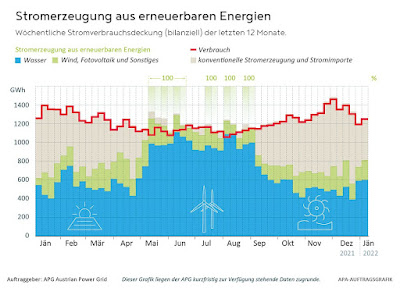
Ein Vorstand der Austrian Powergrid postet folgende Abbildung auf LinkedIn mit dem Ansinnen, dass wir Netze und Stromspeicher ausbauen müssen, um die Versorgungslücke im Herbst und Winter, sowie teilweise Frühling ausgleichen zu können, damit »Eneuerbare« vollständig zur Stromerzeugung genutzt werden können.


Ich bin mir langsam nicht mehr sicher, ob wir es im Bereich der Energieversorgung beziehungsweise des grünen Aktivismus (auch von akademischer Seite!) mit massiver Inkompetenz oder der Verirrung in Wunschträumen zu tun haben.

Wir haben, nach dieser Abbildung, von September bis April ein klares Minus an »Erneuerbaren«. Das ist zum Teil prinzipbedingt: wenig Wind, keine Sonne. Wo wollen wir die absolut gigantischen Stromspeicher bauen die über vier bis fünf Monate geladen und dann acht Monate oder wenigstens ein halbes Jahr dann diese riesigen Strommengen erzeugen?

Und selbst wenn Ihnen das gelänge: wo bauen Sie die ebenso gigantischen Überkapazitäten der »Erneuerbaren« hin, die dann über den Sommer (oder zu Windzeiten im Rest des Jahres) diese Speicher aufladen? Die Energiedichte der »Erneuerbaren« ist so gering, dass sich das nicht einmal rechnerisch ausgeht.

Und wer soll das alles zahlen? Schon jetzt gehen in Mitteleuropa die Energiepreise durch die Decke mit Folgen für Wirtschaft, Produkte und Dienstleistungen. Die Rechnung zahlt der Durchschnittsbürger. Wie lange das politisch gut geht, kann man sich ausmahlen.

Österreich ist hier noch deutlich begünstigt. Viel dramatischer sieht die Situation noch etwa in Deutschland aus. So sieht es etwa heute in Deutschland nach einer milliardenschweren »Energiewende« aus:


Rund 500g CO2 eq/kWh. Überwiegender Teil der Stromproduktion aus Kohle und Gas: Wind, Solar: Reinfall. Dagegen Frankreich:


Rund 90g CO2 eq/kWh. Über das letzte halbe Jahr produziert Deutschland stetig ca. das 4-6 fache an CO2-Equivalenten verglichen mit Frankreich. Und, ich wiederhole mich: nach Milliardeninvestitionen in eine »Energiewende«. So werden wir die notwendige CO2-Reduktion sicher nicht erreichen.

Noch schwerer wiegt allerdings die Nebelgranate, die sich in der Fußzeile der ersten Abbildung findet — dort steht »Stromproduktion«: die heutige Stromproduktion ist aber ein nahezu irrelevantes Maß, da Strom nur ca. 20-30 % der Gesamtenergie ausmacht (im weltweiten Schnitt). Selbst wenn wir also Strom »dekarbonisieren« haben wir fast nichts erreicht. Das ist ein gängiges Muster einger »grüner« Aktivisten, sich auf die Stromproduktion zu fokussieren, selbst wenn damit das Problem nicht einmal im Ansatz gelöst ist.

Anders gesagt: von grüner Seite wird gefordert zu elektrifizieren, sprich: die verbleibenden 70-80% von fossilen Energieträgern auf elektrische umzustellen. An sich eine richtige Idee. Dies führt aber logischerweise dazu, dass der Strombedarf dann über die nächsten Jahrzehnte dramatisch ansteigen wird. Nun sind wir schon heute mit den aktuellen Strategien nicht in der Lage den heutigen Stromverbrauch zu dekarbonisieren.

Können wir beizeiten eine ernsthafte Diskussion führen, die nicht von Ideologien und Glaubenssätzen ausgeht, nämlich, dass »Erneuerbare« diese Herausforderung bewältigen könnten, und vor allem »grün« bewältigen könnten?

Der Klimawandel ist Realität, es wäre hilfreich, wenn die Lösungsvorschläge nicht schlimmer als die Bedrohung werden.

Mehr dazu siehe auch:

Freitag, 24. September 2021

The Philanthropic Trap

In the current liberal discussion we hear the argument that our public services and political system is dysfunctional and broken. It should be replaced by something else, maybe more market-leaning. In this context also philanthropy is mentioned on occasion as example that wealth is not really an issue because many rich people donate their money for »good causes«. In doing so they perform certainly better than our public institutions do. 

I think this is a misguided idea and a good example for how philanthropy often goes wrong is described in the article by Peter Savodnik on Mackenzie Scotts donations against racism:

»It’s not hard for a billionaire like Scott — in her effort to fight inequity or build a brand or out-give other billionaires — to wreak havoc on the itsy-bitsy organizations she showers with her largesse.«

Just being rich (and famous), does not give you any special insight into the human condition or the fate of the world. We also know, that many rich people are not necessarily intellectuals (as seen here) and their donations most likely will do more harm than good.

Even if we assume that the philanthropist is very intelligent, say, like Bill Gates, who also has reasonable ideas about the world and on top of that consults experts to guide his foundation, the question remains: who gave him the right to decide which problems of the world or a country deserve focus and which don't? 

As soon as we allow individuals such a leverage over public health, public goods or the environment, the foundations of our open society is out the window. Philanthropy quickly becomes a form of patronising leadership or turns into oligarchy altogether. The best hope then remains, that these philanthropists/oligarchs are intelligent and well-meaning. Let's look forward to that, or, just to places where oligarchs have a say for a longer time, how that tends to work out ...

Thus the more likely outcome in the long run, are a bunch of incoherent ideas, from well-meaning ones like from the Bill Gates foundation to outright idiotic ones like colonising Mars or the universe or "uploading" our mind into a computer instead of fixing our planet.

***

This is — as a side remark — also an example of the flawed idea of many "progressives", believing, that just because they think they found and understood a problem (which they usually at best have partly) already gives them a clear pathway how to "solve" it. This is misguided. For good reason, some experts avoid the term problem altogether (in complex contexts) and use dilemma instead. Using the term problem leads people to believe there is a single solution (see e.g. Thomas Chermack, Scenario Planning in Organisations, and references there). The term dilemma on the other hand makes it clear, that there is usually no solution to such »problems« but just a meandering between different pathways where each one has potential benefits for some, harms for others and complex risks. A difficult navigation that should not be done by individuals but based on wide societal acceptance.

For my German audience, I made three podcast episodes to exactly that topic:


Montag, 18. Januar 2021

Erwachsenwerden in der Krise

Wir leben in einer Zeit, die von dem Mantra geprägt ist, jedes Problem hätte eine Lösung – und wahrscheinlich sogar eine technische. 

Die Realität sieht anders aus. In fast allen für uns relevanten und existentiellen Herausforderungen haben wir es mit komplexen Problemen zu tun.  Dann ist es weder möglich den aktuellen Zustand hinreichend zu beschreiben (mehr dazu in der Zukunft Denken Episode über Wicked Problems), noch den gewünschten Zielzustand. Es ist weiters nicht möglich die Effekte von Eingriffen (langfristig) vorherzusagen. Wir leben in diesen Situationen häufig eine Planungsillusion, die aber außer hohen Kosten und verlorener Zeit nichts bringt. Letztlich bleibt zumeist nur ein Fahren auf Sicht.

Wir hören auch eine andere Sache ungern: es gibt Probleme, die wir nicht, oder nicht mehr (vollständig) lösen können. Die Klimakrise gehört wohl dazu. Im Jahr 2017 ist ein bemerkenswert offener Artikel im Guardian erschienen, der ausnahmsweise nicht die übliche Machbarkeitsillusion vorgetragen hat: ‘A cat in hell’s chance’ – why we’re losing the battle to keep global warming below 2°C (Keine Chance – warum wir den Kampf die Klimaerwärmung unter 2°C zu halten verlieren.) Ein gutes Dutzend anerkannter Wissenschafter, Klimaforscher, Ökologen usw. kommen zu dem (leider recht offensichlichen) Schluss, dass wir bereits zu sehr in die Erd-System eingegriffen haben und die 2°C Schwelle nur mehr theoretisch halten können. 

Theoretisch auch darum, weil so große Änderungen an unserer Lebenswelt in so kurzer Zeit notwendig wären, die in keinem politischen System realistisch umsetzbar und vermutlich auch instabil sind. D.h. die Medizin wäre vermutlich ebenso schlimm wie die Krankheit. In den letzten vier Jahren ist zudem nichts nennenswertes geschehen um die Emissionen zu bremsen und nach der Corona-Krise ist keine Revolution zu erwarten. Was also vor vier Jahren gegolten hat, gilt heute umso mehr.

Der Philosoph Wolfram Eilenberger sagt:

»Schon vor 30 Jahren war die Erkenntnislage wie heute.« 
»Wenn man sagt, es ist ein Wettlauf mit der Zeit (‘wir haben noch diese drei Jahre...'), dann werden wir diesen Wettlauf verlieren.« 

Wir haben also bei der Klimakrise keine nennenswerte Erkenntnis- sondern eine Handlungslücke von ca. 30 Jahren; sowie, wie ich ergänzen möchte, den vielfachen Versuch diese Handlungslücke zu erklären und durch andere Öffentlichkeits- und Politik-Maßnahmen zu verbessern. Nichts davon hat bisher zu den wissenschaftlich notwendig erklärten Schritte geführt.

Ich denke, es ist Zeit, eine erwachsene Diskussion zu führen und das Wunschdenken loszulassen. Das Verbessern oder besser, der Umgang mit realen Problemen ist ein langfristiger Transformationsprozess. Auch wenn wir es gerne hätten:  Revolutionen scheitern in der Regel und führen eher in die Katastrophe. Wir haben idealistische Ideen, wie die Welt besser sein soll, aber ein revolutionäres Neu-Design muss an der Komplexität, den Wechselwirkungen und der mangelnden Vorhersagefähigkeit scheitern. 

Ich weiß auch nicht genau, was die gesellschaftliche Folge dieses Erwachsenwerdens wäre, bin aber überzeugt davon, dass eine Gesellschaft, die nur in zwei Polen lebt – auf der einen Seite der Negierung auf der anderen Seite des Wunschdenkens – keine Zukunft hat.

Ein solcher Transformationsprozess benötigt leider Zeit. Die Folge wird sein, dass wir wesentliche Klimaziele nicht erreichen werden – mit allen daraus folgenden negativen, ja katastrophalen Konsequenzen. Woraus eine weitere Erkenntnis folgt: ein Vorbereiten auf das Scheitern wird neben allen anderen Maßnahmen notwendig sein. 

“Die rettende Idee besteht schlicht darin, dafür zu sorgen, dass die menschlichen und Berechnungsfehler beschränkt bleiben, und zu verhindern, dass sie sich im System ausbreiten”, Nassim Taleb

Dienstag, 29. Dezember 2020

Das Versagen der Effizienten

Eine der wichtigsten Fragen, die wir aktuell viel zu wenig diskutieren: Warum sind viele der  Organisationen (WHO, Ministerien, Rechtssystem, Universitäten/Forschung...) so verheerend schlecht im Umgang mit den existentiellen Problemen der Zeit?

Ein Aspekt dürfte im Alter der Organisation liegen: Alter bedeutet häufig Versteinerung. Strukturen und Hierarchien werden dominant, verknöchern und sind zu kaum einer Flexibilität mehr fähig. Diejenigen im System haben keinerlei Interesse Risiko einzugehen, business as usual aber (und nur darin sind wir richtig gut) führt die anderen in die Krise.

Dies ist ein Problem, vor allem auch gepaart mit der Tatsache, dass sich Prozesse in modernen Gesellschaften evolutionär ändern –was an und für sich eine gute Sache ist – aber alte Zöpfe fast nie angegriffen werden. Persönliche Risikovermeidung der Führungskräfte führt zu Risikomaximierung der Allgemeinheit. Die Folge ist ein Schichtenbau an Komplexität, wo das Neue fast nie das Alte ablöst. Wir beobachten archäologische Schichten über Schichten an neuen Prozessen, die mit alten und älteren Prozessen, Prozeduren, Strukturen interagieren. Irgendwann wird jede Veränderung nahezu eine Unmöglichkeit. Seiteneffekte sind nicht mehr greifbar, Ziele kaum erkennbar.

Der Hauptpunkt aber ist, dass wir mit Transparenz, Effizienzsteigerungen und Digitalisierung (TED) eine Menge Schaden angerichtet haben, ohne dies zu wollen. Wir haben nicht verstanden, dass diese Maßnahmen ein zweischneidiges Schwert sind. Die eine Schneide haben wir betrachtet und beworben: Verhindern von Korruption, Beschleunigung von Prozessen, Streamlinen, Offenheit von Organisationen, Klarheit von Entscheidungen, (kurzfristig) niedriger Kosten usw. 

Die zweite Schneide haben wir übersehen: Diese TED-Maßnahmen sind vergleichbar mit einem Kompressor in der Audio-Technik: ein solcher Filter drückt Wellenformen bildlich gesprochen zusammen. Laute Anteile werden leiser, die leisen werden lauter.

Die Schwächsten in unseren Organisationen haben wir etwas angehoben, den Missbrauch Einzelner etwas reduziert und das Mittelmäßige optimiert – soweit nach Plan. Was wir nicht bedacht haben ist, dass wir auch alles Exzeptionelle kaputt gemacht haben. Der Herausragende kommt nicht aus einem Standard-Prozess, kommt niemals aus einer Effizienzmaßnahme. 

Der hervorragende Denker und Macher(!) wird durch Transparenz nicht besser, sondern schlechter. In der Regel wesentlich schlechter. In Zeiten von Krisen, in Zeiten wo fundamentales, kritisches, übergreifendes, unkonventionelles Denken und aktives Handeln dringend benötigt wird, erkennen wir die Nutzlosigkeit der Strukturen und Personen in den Strukturen, die wir über die letzten Jahrzehnte »optimiert« haben. Erkennen wir, dass sie viel mehr Schaden anrichten als Nutzen stiften. Ja, wir bekommen einen neuen Pass in drei Tagen statt zwei Wochen. Das ist gut für die KPIs der Management-Berater und das Selbst-Marketing der Minister. Kein nennenswertes Problem der Welt wird dadurch besser. Wenn es darauf ankommt, wenn das inkompetente Handeln richtige Schäden für Generationen anrichtet – wie jetzt in Pandemie- und Klimakrisen-Zeiten – versagen wir. 

Mit anderen Worten: wir haben unsere Systeme mit großem Engagement für das falsche Problem optimiert.

Wenn wir als Menschheit eine Zukunft haben, dann liegt diese nicht in TED-Zombie-Mitarbeitern sondern in Strukturen, die ein gewisses Maß an Effizienz, Transparenz und Digitalisierung haben, aber keinesfalls zu viel. Die Unangenehmen, die Unangepassten, die außerhalb des Prozesses agieren, die Selbstorganisation, Flexibilität und Eigeninitiative zum Prinzip haben, machen den Unterschied.

Samstag, 14. November 2020

The long shadow of innovation, or: Lean digitisation and the car

 Inception of Technology

The inception of technology often runs through the following stages: luxury, wider adoption followed by systemic effects and finally this technology often becomes infrastructure and we become dependent from it. What once was fancy, a luxury eventually became a requirement for our life and for other processes in our society.

These steps can easily be followed with the car as with many other technologies (electricity, elevator, telephone, internet, etc.) Some of the systemic effects are predictable early on, many are not and need to be constantly monitored. A technology becoming infrastructure puts a huge burden on society: infrastructure is hard to change and usually expensive to maintain. This does not mean we should not build infrastructure, but we should be very careful what we add to our existing infrastructure and in which exact implementation. 

The Car

The car is an excellent example of a technology that was very badly steered in its inception, thus inflicted massive damage on societies. Instead of using the benefits of the car cleverly, we made large parts of our society dependent on it, severely damaged the social fabric in cities and villages, harmed the environment and living standards in the process. In some countries the situation is obviously much worse than in others. The US took a specifically bad route. Lee Vinsel et al describe this as

»the great American experiment of suburbanisation.« after the second world war. »They were, in the scope of human history, extremely low-density “towns,” and yet they also required more intense infrastructure: more roads, more sewer and water pipes, more utilities.«, Vinsel, Lee; Russell, Andrew L. The Innovation Delusion

The focus here is: more roads are needed, because everyone became heavily dependent on the car. They continue:

»the initial postwar suburban boom pales in comparison to what happened next. Beginning in the 1960s, white flight and other factors hollowed out the economically productive city centres throughout the country, leaving dead downtowns that were largely devoid of life outside business hours. Infrastructure has rotted in the so-called Rust Belt and in cities around the country where tax bases have evaporated.«

Dependency is unfortunately not linear but usually multiplies and creates webs of dependencies. Housing is dependent on the previous one(s): car, road, then follow electricity supply in the suburbs, food supply, etc. Once multiplied it gets harder and harder to correct these substantial mistakes. 

Parts of Europe did indeed a bit better – specifically cities – but not necessarily because we did more clever planning. Politicians were simply more bound by old city infrastructure and architecture. In plain words: the older and nicer, more social buildings, squares, architecture from the 19th century and before saved us to do the worst mistakes. Nonetheless, some politicians actually used the phrase car friendly city. What an absurd twist of facts: suddenly we have to accommodate technology not the other way round: take care of peoples needs and ask, how technology could help.

Today, many cities recognise that they took a very wrong turn and start to understand the damage this path inflicted on people. In some progressive cities like Amsterdam or Paris politicians try to undo (parts) of these mistakes. But as the car became (»webbed«) infrastructure, this turns out to be very costly and difficult – even in cities that are not as dependent on cars like cities in the US or some Asian countries .  

The bottom line here is this: it is much, much easier to introduce a new technology than to get rid of this technology again – after we became dependent. 

Digitisation on the brink of chaos

Now we stand on a similar junction with digitisation. Digitisation meaning: transforming formerly »analogue«, human driven processes to digital, computer based ones. 

With digitisation – as with many other innovations – we did not learn from past experiences with other technologies and severe mistakes we made there (on a structural, meta-level). We particularly did not understand how costly bad decisions can get over time. Now, thinking before acting is generally good advice. Doing what is technically feasibly, not matter what (and calling it innovation) – not so much.

Until recently, reasonable people who asked for slowing down a bit, to deliberate before jumping onto the next bandwagon where ridiculed. We (and I am saying intentionally »we«, because I am guilty myself) called them names like »Internetausdrucker« (old farts you print out the internet) etc. However, it turns out: slowing down things a bit is actually a bright idea.

Particularly as we start seeing the devastation that the move fast and break things ideology inflicted on our society. I am not going into details here, because these effects are discussed everywhere these days; just some hints: (a)social networks, monopolies we cannot fight any longer because they became more powerful than states, »disruptive« enterprises like Uber that never made a buck, but in the process destroyed hard fought rights of the poorest in a society, surveillance capitalism and many, many more. 

And we have not even seen the worst: long term effects of short term gains (for consulting agencies, »digitisation experts«, monopolies) turn out to be terrible. Why? As Vinsel et al correctly point out: innovation is (the starting point) everyone talks about. What is not talked about is: every technology we introduce into our world has to be maintained. Specifically when it becomes infrastructure as argued in the beginning. Now this is problematic enough, because in the digitisation projects usually only the short term gains and costs are argued for. It is forgotten that long term maintenance can become very expensive. By various reasons: for one, the overall complexity of the IT infrastructure is rising and complexity tends grows much faster than the benefits and faster than our means to keep up with it.

What makes things worse is that the implementation quality of many (read: most) IT systems is abysmal. This low quality of implementation multiplies the effects mentioned before. What we will see is: (1) long term dependence on systems that were introduced with not a lot of foresight in mind where (2) the costs will outnumber all benefits in mid term.

What was supposed to be efficient will turn out as uncontrollable pain in the ass. Or as Nassim Taleb put it astutely: 

»Most modern efficiencies are deferred punishments«

However, to be clear: most of us will be punished if we continue the current path, but a small minority (as we well know in our current economic condition) will collect the majority of the gains. 

Luddites!

I hear you say. No. It is not my point that we should throw all our digital systems out. It is s not to say that we cannot benefit from digitisation. We can, if we do it cleverly. But there is absolutely no time to loose to change the current path. To outline a few concrete aspects to consider for a lean digitisation in the future: 

  1. Digitisation is not a value per se.  It has to be well argued for. Don't do it because it is fashionable or your consulter tells you that you will miss the next disruption if you will not (and all others are doing it too (he tells them the same thing about you)). Were no clear and long term benefits can be reasonable argued, stay analogue, human.
  2. Innovation per se is nothing; Innovation essentially means: we introduced something new. Progress is what counts. Progress requires deep thinking and monitoring of the impacts of innovation. It has to be explicitly on the agenda. We have to ask the difficult questions, not evade them. Questions that ask for qualities not quantities.
  3. As far as software is concerned: Software is rarely isolated. If you develop software for a company, organisation etc., chances are, you will be part of a complex web of dependencies that tend to become infrastructure just by the fact that no one knows any more what is part of a process and what is not. This includes data dependency and process dependency. Hence Datensparsamkeit was only the first important idea. Dependency frugality (as I would call it) has to be the second. Be as independent as conceivable (e.g. never use cloud services of monopolists).
  4. We face deep knowledge loss, because knowledge that is embedded »in humans« and »analogue« processes gets captured in IT systems. Usually people operating these systems loose this knowledge quickly.  If not managed properly you will end up in a decade with a technical system that does something — arguably correctly, but you really don’t know — and no one in your Organisation can tell you any more what this system is doing. Combined with the usual bad engineering: good luck changing, migrating or even retiring this system. 
  5. We have to consider long term costs. In many cases it will turn out that long term costs will by far eat short term benefits.
  6. We face severe, possibly existential security risks in our current low quality but highly connected digital infrastructure.
  7. We most importantly have to consider maintenance of each innovation introduced, avoid innovation where maintenance is unclear (e.g. home automation)

These are just some bits and bobs that should be analysed more systematically and deeply to illustrate what should be done. 

The bottom line is: we can and should learn from past examples like the crude introduction of the car into our lives. What seemed like a good idea at the time turned out to be a terrible mistake. It will cost us dearly in the future to get rid of the car again in many places, survive the environmental and the systemic damages. We could have much more liveable cities, more resilient mobility and – indeed – the car for certain useful cases. We had the choice but did not take it. 

We (still) have the choice with digitisation. We can do it better, we can do lean digitisation, or clever digitisation, however you want to call it, or we can follow the current path. This will cost us a fortune in a few decades.

***

Addition on 29.11.2020 

In the last days an Amazon AWS datacentre had problems and a number of cloud services did not work properly any longer. The consequence? A large number of (US) web services did not work any more or not reliably because they were all dependent on this cloud service.

But not only web-services were affected: our modern digitisation is so driven by terrible architectural decisions (and demands from surveillance capitalists) that also door bells, thermostats and vacuums (among other devices) stoped working.

Incidentally, this is exactly the same point that Nassim Taleb is regularly making: volatility is not the problem. There is no systemic risk. The problem is idiotic concentration of services for pseudo-efficiency which makes the whole system fragile. We are transforming the internet – which was inherently resilient – into a fragil behemoth that risks our global digital infrastructure.

Addition on 17.12.2020 

It became clear that large parts of US (government) networks were hacked. To quote from the NYT article:

»The magnitude of this national security breach is hard to overstate.«

»The Russians have had access to a considerable number of important and sensitive networks for six to nine months.« 

 »The logical conclusion is that we must act as if the Russian government has control of all the networks it has penetrated.«

 To be clear: the fact that such a wide spread and devastating hack is possible is to a large extent the consequence of a very poor digitisation strategy and low execution quality. And it is certainly just to tip of the iceberg. 

Move fast and break things was finally successful: a lot of essential things are broken now. The more important answer was not given by Zuckerberg though: will we be able to repair this mess and who will pay for it? 

Addition on 28.02.2022 

The Russian war on Ukraine again stresses the point I tried to make two years ago. Over-reliance on actually unnecessary technology and the lack of alternate pathways — which are a fundament for resilience — celebrating simplistic efficiency, is getting back at us now. Let's learn from the damage as long as we still can: 

  • no unnecessary technology
  • the technology we deploy has to be well maintained
  • no single points of failure
  • no magic thinking (renewables will save our future etc)
  • no efficiency at the cost of resilience.

Donnerstag, 9. April 2020

Der Reboot-Mythos: Warum wir unsere Gesellschaft nicht »neu starten« können, und sich kein Phoenix aus der Asche erheben wird

Gerade in Zeiten der Krise liest und hört man immer wieder Geschichten, Phantasien, manchmal auch Schreckens- oder gar Wunschvorstellungen, unsere (globale) Gesellschaft könnte kollabieren und dann einen sogenannten Reboot durchleben. Wie ein Phoenix aus der Asche könnte eine neue, bessere Gesellschaft aus den Ruinen der alten aufstehen. Wir beginnen also von vorne, aber wissen es besser.

Es wird keinen Phoenix geben. Es wird eine Transformation unserer Gesellschaft oder Asche geben. Warum ist das so?

Derzeit kann man diesen Ideen kaum entkommen, so häufig tauchen sie an allen Ecken und Enden auf. Von extremen Umweltaktivisten im linken bis zu fundamentalen Christen im rechten politischen Lager. Und dennoch sind sie auf so vielen Ebenen falsch. Denken wir alleine daran, dass viele Menschen es unter keinen Umständen friedlich zulassen werden, dass ihr vermeintlich verdienter Lebensstandard reduziert wird und eher alles zerstören als kontrolliert »herunterfahren« würden. 

»The American way of life is non-negotiable.«, ist ja ein bekannter Spruch der Wahlwerbung der Republikaner in den USA.

Aber lassen wir soziologische und politische Aspekte – so wichtig sie sind – einmal beiseite und beschränken wir uns hier nur auf einen systemischen, aber extrem wichtigen Blickwinkel:

Es ist den meisten Menschen trotz Corona-Krise noch nicht klar geworden, dass wir nicht nur in einer extrem arbeitsteiligen Welt leben – das heißt kaum mehr jemand versteht wie ein bestimmtes Produkt entsteht wird (ein wunderbarer »historischer« Artikel dazu ist I Pencil) – und mittlerweile auch nicht mehr wer dies tut und wer weiß was zu tun ist. Produkte laufen in immer komplexeren Lieferketten um die halbe oder ganze Welt, bis sie fertig sind. 

Wir haben also ein erhebliches Know-How Problem und dieses steckt eben nicht nur, oder ich würde sagen nicht einmal hauptsächlich in den Köpfen der Menschen, sondern in den Systemen und Strukturen. Siehe dazu das wunderbare Buch von Andy Clark, Being There (Hervorhebungen von mir):
»In a sense, then, human reasoners are truly distributed cognitive engines: we call external resources to perform specific computational tasks [...] Brain and world collaborate in ways that are richer and more clearly driven by computational and informational needs than was previously suspected
[…] 
In these cases it would seem, we solve the problem (e.g. building a jumbo jet or running a country) only indirectly-by creating larger external structures, both physical and social, which can than prompt and coordinate a long sequence of individually tractable episodes of problem solving, preserving and transmitting partial solutions along the way.«
Mit einem Kollaps würden aber gerade diese Strukturen zerstört werden, und niemand, absolut niemand ist in der Lage aus dem Studium eines Lehrbuchs ein iPhone oder ein Hochhaus zu bauen oder zu warten.

Was aber fast noch wichtiger ist: wie leben in einem autopoietischen, selbst-strukturierenden System, wo sich die Komplexität, die zur Selbsterhaltung notwendig ist, stetig nach oben geschraubt hat. Was meine ich damit, an einem Beispiel:

Vor 100-200 Jahren lag der EROEI (energy returned on energy invested), also die Energie die man gewinnen konnte im Verhältnis zur eingesetzten Energie bei der Gewinnung bei Öl bei ca 1:100. Für eine Energieeinheit die man eingesetzt hat, hat man also rund 100 Einheiten gewonnen. Bei den schlechtesten Formen die heute ökonomisch betrieben werden, Ölsande etwa, liegt dies bei vielleicht 1:5.

Aber nicht nur die Effizienz ist dramatisch gesunken, gleichzeitig ist der technische Aufwand enorm gestiegen, und zwar Aufwand, der eine extrem komplexe Infrastruktur benötigt. Denken wir an den Bau und die Erhaltung von Ölbohrinseln und Bohr-Verfahren, wo nicht einfach ein vertikales Loch gebohrt wird und Öl heraussprudelt wie in Texas vor ~150 Jahren, sondern wo mit computergesteuerten Verfahren der Bohrer – etwas unernst ausgedrückt – dreimal ums Eck fährt bis er an die benötigte Stelle gelangt, wo sich die letzten Öl- oder Gasvorkommen befinden.

Wir haben also immer längere Leitern gebaut um an die immer höher hängenden Früchte zu gelangen. Verlieren wir diese Leiter ist das Spiel zu Ende. Denn es gibt keine niedrig hängenden Früchte mehr, die haben wir in der industriellen Revolution und danach geerntet und haben diese betrieben und auch das ökonomische Wachstum der 1950er bis 1970er Jahre befeuert. Die hoch hängenden Früchte aber werden wir nicht mehr erreichen. Denn um diese zu ernten haben wir zuvor die Energie der niedrig hängenden Früchte benötigt. Und zwar sowohl aus technischer wie aber auch aus ökonomischer Sicht. 

Ein fataler Teufelskreis!

Dies betrifft natürlich nicht nur die Produktion von Öl. Das war ein mehr oder weniger beliebiges Beispiel, sondern fast alle Aktivitäten, die Rohstoffe benötigen, komplexe Produkte bauen oder komplexe menschliche Aktivitäten (wie Städte oder digitale Infrastruktur) am Leben halten.

Dieser Herr präsentiert stolz eine Kühl-Einheit die benötigt wird, um den vom Klimawandel tauenden Permafrost in Alaska wieder mechanisch zu kühlen (sic!) um die Bohranlangen, die im Permafrost installiert wurden um nach Öl zu bohren, der die Klimakrise anheizt, weiter stabil zu halten. 

Was ist die Konsequenz daraus: es wird wohl keinen Reboot geben, sind wir einmal (z.B. durch gesellschaftlichen Kollaps in Folge der Klimakrise) nennenswert tief gefallen. Es bleibt die Frage, wo der Schwellenwert liegt. Fallen wir unter diesen, kann sich vielleicht eine kleine Population auf dem Niveau von Jägern und Sammlern erhalten. Jedenfalls dann, wenn dieser Kollaps nicht durch massive Kriegshandlungen z.B. mit Atomwaffen begleitet ist, was aber leider ein recht wahrscheinliches Szenario ist. Wer glaubt allen Ernstes, dass eine Atommacht »in Ruhe« stirbt und untergeht?

Bleiben wir über diese Schwelle der komplexen Handlungsfähigkeit – wie ich sie nennen würde – haben wir noch eine Chance, Dinge neu aufzubauen, aber das Risiko ist enorm unter diese zu sinken.

Was wir daraus lernen sollten ist aus meiner Sicht ziemlich einfach: Wir können unsere Gesellschaft ändern aber transformativ, evolutionär. Wir dürfen aber niemals einen zu großen Einbruch oder Kollaps riskieren, da wir zu jedem Zeitpunkt auf relativ hohem Komplexitätsgrad handlungsfähig müssen, bis wir einen neuen autopoietischen und dynamisch stabilisierten Zustand erreicht haben.

Zum Abschluss...

Es freut mich, dass Sie sich die Zeit genommen haben, mein Blog zu lesen. Natürlich sind viele Dinge, die ich hier diskutiere aus einem subjektiven Blickwinkel geschrieben. Vielleicht teilen Sie einige Ansichten auch nicht: Es würde mich jedenfalls freuen, Kommentare zu lesen...

Noch ein Zitat zum Schluß:

"Ich verhielt mich so, als wartete ein Heer von Zwergen nur darauf, meine Einsicht in das Tagesproblem, zur Urteilsfindung von Gesellschaft und Politik zu übersetzen. Und nun stellt sich heraus: Dieses Heer gibt es nicht.

Ganz im Gegenteil erweist sich das kulturelle Getriebe als selbstimmunisierend gegen Kritik und Widerlegung. Es ist dem Lernen feind und wehrt sich in kollektiver Geschlossenheit gegen Umdeutung und Innovation.", Rupert Riedl, Evolution und Erkenntnis, Piper (1985)

:-)